By University of Texas at Austin · December 2, 2025 · SciTechDaily
Researchers created a highly efficient gene-editing method that fixes multiple DNA mutations in a single step.
The breakthrough could revolutionize genetic medicine by making treatments for complex diseases faster and more inclusive.
The Challenge of Treating Complex Genetic Diseases
Some genetic disorders—such as cystic fibrosis, hemophilia, and Tay Sachs disease—involve multiple mutations across a person’s genome. The number and type of mutations can differ widely, even among people diagnosed with the same condition. This variation makes it difficult to design gene therapies that work for large groups of patients instead of only those with specific mutations.
New Gene Editing Approach Developed at UT Austin
Researchers at The University of Texas at Austin have created an enhanced gene-editing technique that offers greater precision and higher efficiency than earlier methods. This approach can correct numerous disease-related mutations at once in mammalian cells. The team also used it to successfully repair mutations linked to scoliosis in zebrafish embryos.
The breakthrough relies on retrons, which are genetic components found in bacteria that help protect them against viral infections. This marks the first time scientists have used retrons to fix a disease-causing mutation in vertebrates, opening the door to new possibilities for gene therapy in humans.
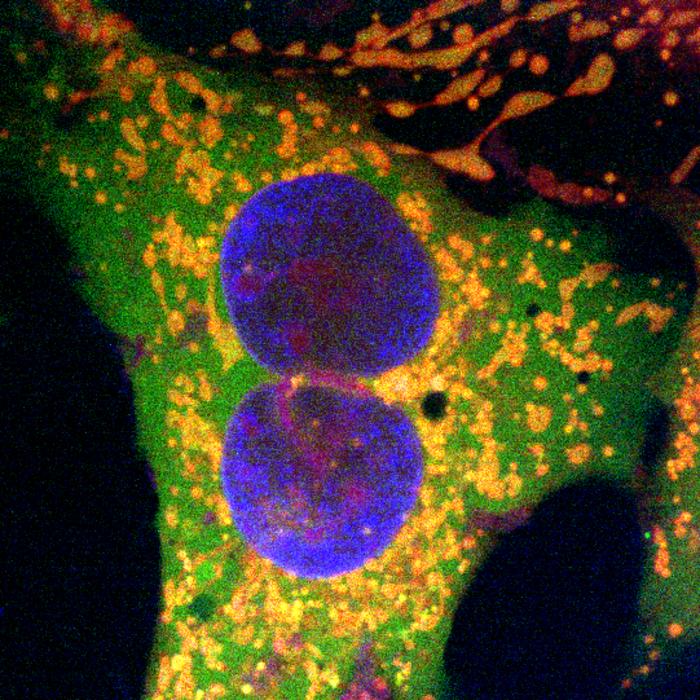
Human cells that have been edited with the new retron-based gene editing technology. Orange dots mark successful gene edits. Green dots show a fluorescent protein tag on the surface of mitochondria. Credit: You-Chiun Chang/University of Texas at Austin.
A Broader and More Inclusive Editing Strategy
“A lot of the existing gene-editing methods are restricted to one or two mutations, which leaves a lot of people behind,” said Jesse Buffington, a graduate student at UT and co-author of a new research paper in Nature Biotechnology. “My hope, and what drives me, is to develop a gene-editing technology that’s much more inclusive of people who might have more unique disease-causing mutations, and that using retrons will be able to expand that impact onto a much broader patient population.”
Buffington co-led the study with Ilya Finkelstein, a professor of molecular biosciences at UT. Their work received support from Retronix Bio and the Welch Foundation.
Replacing Faulty DNA in a Single Step
This retron-based method can substitute a long stretch of damaged DNA with a healthy version. Because it repairs an entire segment rather than one mutation at a time, the same retron package can correct many different mutations located within that region, without needing customization for each patient’s unique genetics.
“We want to democratize gene therapy by creating off-the-shelf tools that can cure a large group of patients in one shot,” Finkelstein said. “That should make it more financially viable to develop and much simpler from a regulatory standpoint because you only need one FDA approval.”
Major Improvement in Editing Efficiency
Previous attempts to use retrons for gene editing in mammalian cells achieved very limited success, with the best systems inserting new DNA into only about 1.5% of targeted cells. The UT Austin method shows a dramatic improvement, reaching about 30% of targeted cells. Researchers believe they may be able to raise this efficiency even higher with future refinements.
Another advantage is that the retron system can be delivered as RNA packaged inside a lipid nanoparticle. These nanoparticles are specifically designed to overcome delivery challenges that affect many standard gene-editing tools.
Targeting Cystic Fibrosis With Retron Technology
The UT team is now applying this approach to cystic fibrosis (CF), a disorder caused by mutations in the CFTR gene. These mutations lead to thick mucus in the lungs, persistent infections and gradual lung damage. A recent grant from Emily’s Entourage, a non-profit focused on the 10% of CF patients who do not respond to current therapies, will help support this work.
Researchers have begun replacing defective regions of the CFTR gene in cell models that mimic CF disease processes and plan to extend the work to airway cells derived directly from CF patients.
Expanding Treatment Possibilities for Rare Mutations
“Traditional gene-editing technologies work best with single mutations and are expensive to optimize, so gene therapies tend to focus on the mutations that are the most common,” Buffington said. “But there are over a thousand mutations that can cause CF. It’s not financially feasible for companies to develop a gene therapy for, say, three people. With our retron-based approach, we can snip out a whole defective region and replace it with a healthy one, which can impact a much larger part of the CF population.”
A separate grant from the Cystic Fibrosis Foundation will support similar research on the area of the CFTR gene that contains the most widespread CF-causing mutations.
Reference: “Discovery and engineering of retrons for precise genome editing” by Jesse D. Buffington, Hung-Che Kuo, Kuang Hu, You-Chiun Chang, Kamyab Javanmardi, Brittney Voigt, Yi-Ru Li, Mary E. Little, Sravan K. Devanathan, Blerta Xhemalçe, Ryan S. Gray and Ilya J. Finkelstein, 23 October 2025, Nature Biotechnology. DOI: 10.1038/s41587-025-02879-3
Archived from SciTechDaily on 2026-02-09.