Yikes! I don’t think anyone realized just how many academic norms rested on the fact that writing is rate-limiting. Writing used to be hard, so if you bothered to write, we all took it to mean you’d spent time developing the idea. That was a convenient fiction.
In the LLM era, I guess we’re all learning Brandolini’s law:
The amount of energy needed to refute bullshit is an order of magnitude bigger than that needed to produce it.
— Alberto Brandolini, January 11, 20131
Moving forward, I’ll be collecting examples of how the slop firehose is drowning academic scientists and institutions.
Grants and funding
A global uptick in new grants
Across 12 funders in six countries and the EU, applications rose 57% on average from 2022 to 2025.
When both proposals and reviews are mediated by agents that are trained on the same body of previously funded work, the system will no longer be evaluating the quality of ideas. It will be evaluating how well agents have learnt to simulate the ideas that funders have previously rewarded.
— Geraint Rees and James Wilsdon, Nature, April 27, 20262
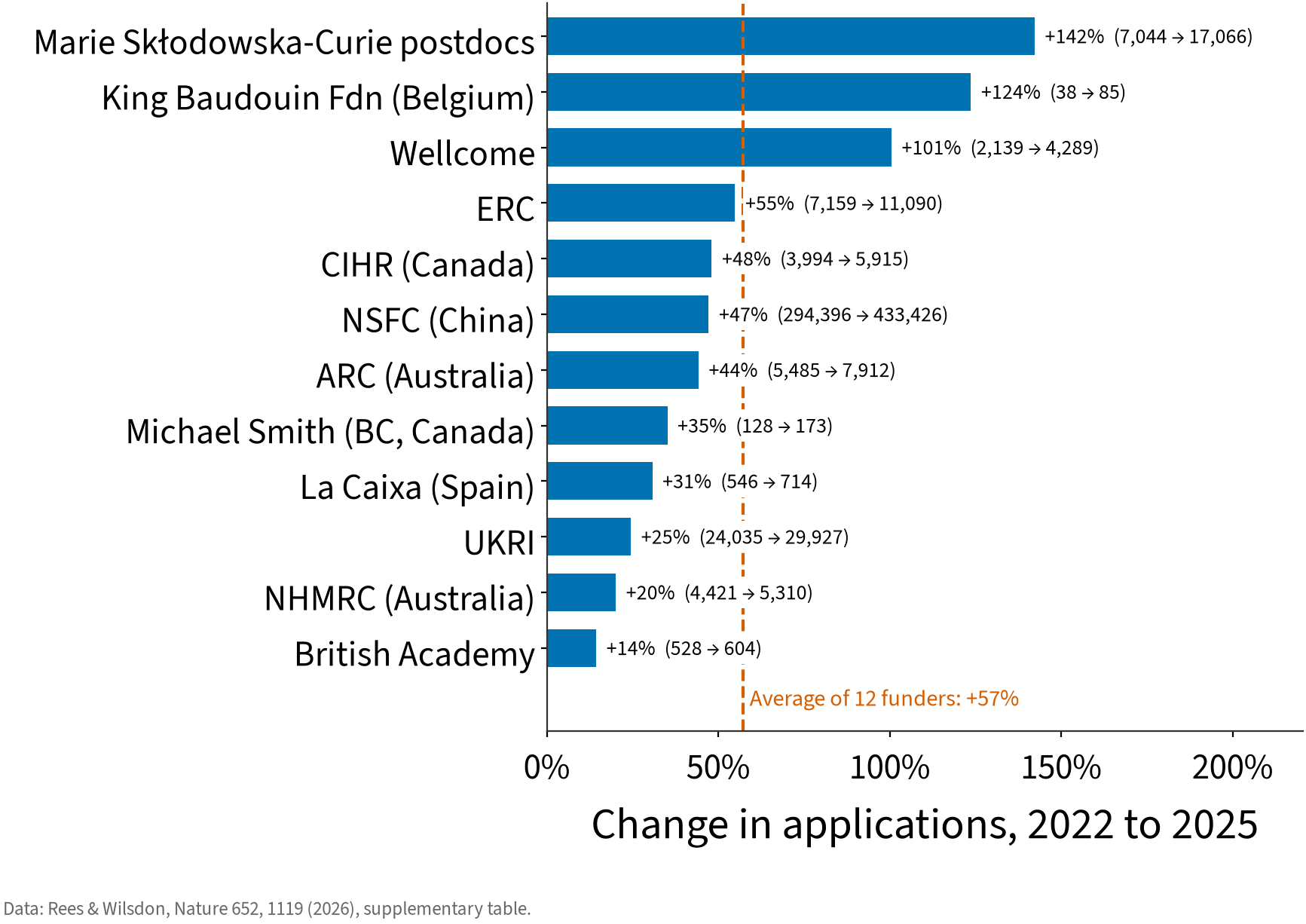
The EU’s prestigious Marie Skłodowska-Curie Postdoctoral Fellowships are absolutely drowning in slop!
This is the highest number of applications received for MSCA Postdoctoral Fellowships to date and the highest number of proposals ever for any funding action in the 40 years of EU research and innovation framework programmes.
— European Commission, September 11, 20263
NIH caps applications
Since September 25, 2025, NIH accepts at most six applications per PI per calendar year, and will not consider applications “substantially developed by AI.”
There is evidence that the use of AI tools has enabled Principal Investigators to submit more than 40 distinct applications in a single application submission round.
— NIH, NOT-OD-25-132, July 17, 20254
What does that mean? Nobody knows! The first rule of Academic Fight Club is “you don’t talk about … AI-assisted writing.”
(Let’s break that rule. I use LLMs to help with my writing, this post included.)
Center for Scientific Review (CSR) triages two thirds of applications
CSR’s mission is to review nearly all new NIH grant applications.5
More than 35,000 applications are already in review for the January 2027 council, past the record 33,640 for May 2026. Study sections will discuss a third of applications, down from the usual ~50%.
NIH finds it necessary to continue modified peer review practices to effectively review an unprecedented number of grant applications.
— NIH, NOT-OD-26-114, September 8, 20266
European Research Council (ERC)
The ERC is the EU’s funder of investigator-driven frontier research.7 Starting Grant proposals rose 22% in the 2026 call, after 13% the year before.8
Recently the number of applications has been rising dramatically. Some panels now have more than 250 applications to assess and we expect this upward trend to persist.
— Maria Leptin, ERC President, April 16, 20269
Wellcome
Likewise, most UK and European funders all reported 50 to 100% more applications in their most recent round (2026).
It is likely that the use of AI is making applying for grants easier and driving up numbers. […] A rise in applications places an unsustainable strain on our operations and the capacity of peer reviewers.
— Alyson Fox, Director of Research Funding, Wellcome, July 14, 202610
Publications
arXiv
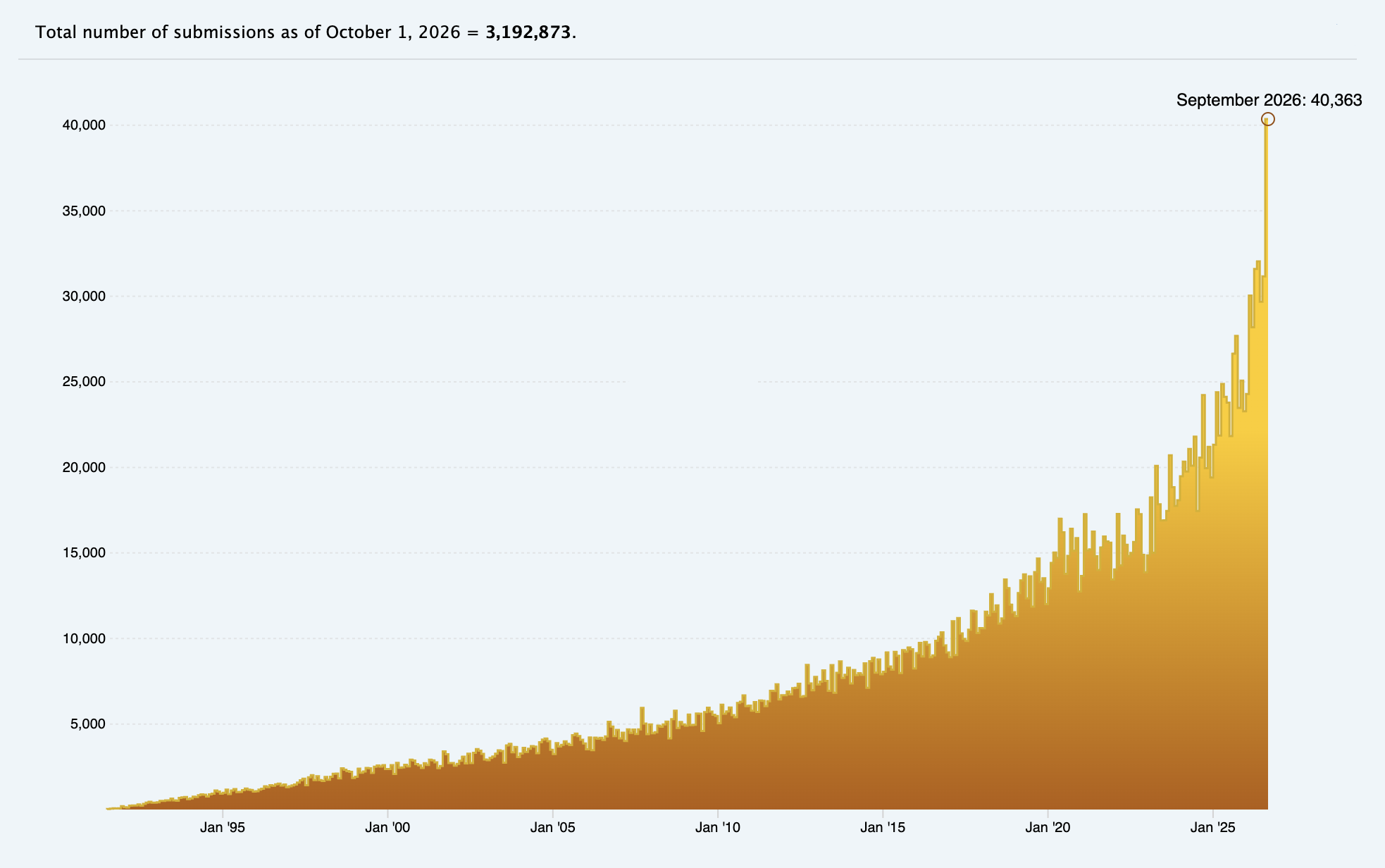
The entire arXiv post is worth reading for the astounding explosion in arXiv submissions. Clearly, something has to change.
A relatively small proportion of authors are submitting a large number of low-quality papers and consuming a disproportionate fraction of the moderators’ time. This is unfair to authors who continue to submit quality papers — their papers can be delayed for days or weeks as a result.
— Thomas Dietterich, chair of the arXiv Editorial Advisory Council, October 1, 202611
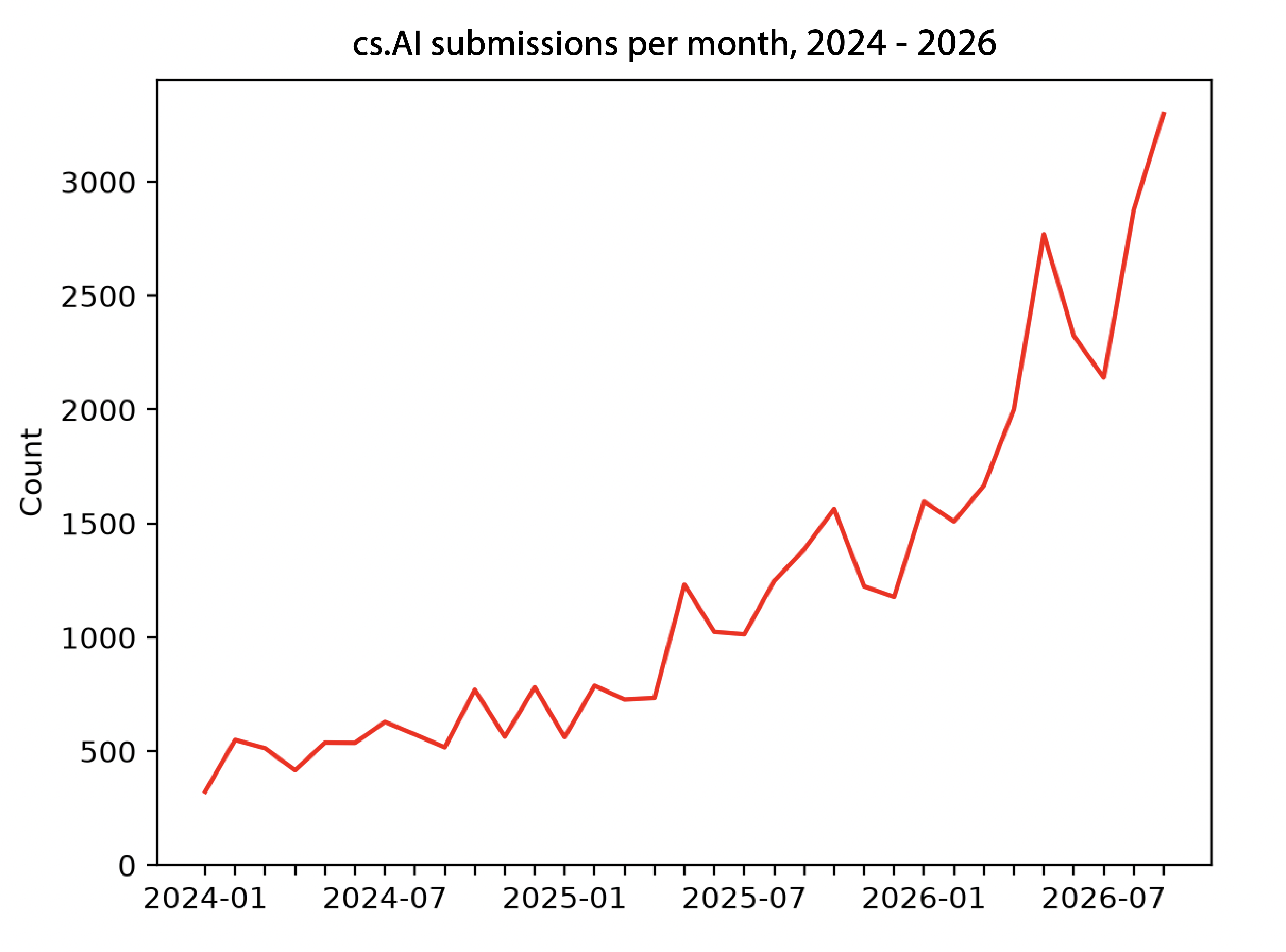
Incidentally, I would love to know whether bioRxiv is also undergoing the same type of slop attack.
Journal submissions
Journals on ScholarOne got 33% more submissions in Q1 2026 than a year earlier. This burden is falling disproportionately on smaller journals, which got 81% more submissions. Desk rejections grew 72% from 2022 to 2025. This is a massive strain on volunteer editors.
The editorial labor problem is more acute, and I think it is the least discussed consequence of this surge. The journals absorbing the most disproportionate growth are exactly the journals with the least infrastructure.
— Josh Dahl, The Scholarly Kitchen, May 13, 202612
Letters to the editor
Clinical Orthopaedics and Related Research got more letters in the first half of 2025 than in any full year before. About half were likely written by an LLM.
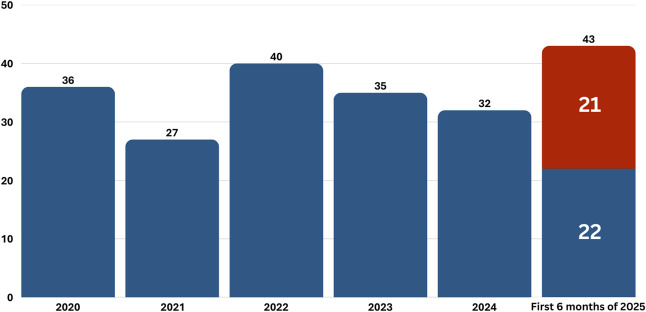
We have too much respect for our readers to flood the zone with so much empty content.
— Samantha League Smith and Seth Leopold, CORR, August 4, 202513
JAMA bans AI-written letters
JAMA went further. As of August 10, 2026, it no longer allows AI to draft opinion pieces, letters to the editor or online comments at all, after a surge of submissions in exactly those formats.
We have seen marked increases in submissions of these types of articles, occasionally from the same authors, who may not have expertise in the topics they are addressing. These submissions are often formulaic and lack useful insights.
— Annette Flanagin, Roy Perlis and Kirsten Bibbins-Domingo, JAMA, August 10, 202614
AI conferences
AAAI received more than 30,000 submissions for 2026, double the ~15,000 for 2025.
The rising scale of submissions means we face increasingly overburdened reviewers with more papers assigned, the need to recruit an ever-wider pool of potentially less experienced reviewers, and increasingly compressed timelines.
— Joydeep Biswas et al., April 15, 202615
AI-written peer review
Of course, scientists are also increasingly offloading peer review. For example, the International Conference on Learning Representations (ICLR), one of the top machine-learning venues, had 19,525 submissions for 2026 and 76,139 reviews from 18,054 reviewers. Pangram, which sells an AI-text detector, estimated that about 21% of the reviews (15,899) were fully AI-generated, and that more than half had some AI involvement.16
The large scale of reviews (over 75,000) made it impossible to rely on human judgement alone to consistently flag and discover problematic reviews.
— ICLR 2026 Program Chairs, March 31, 202617
So ICLR started a game of cat-and-mouse, which I’ll be watching with great amusement. A poor man’s steganography,18 if you will. They embedded a hidden prompt in some PDFs that nudged LLMs to use telltale phrases. The results were, as you’d expect…discouraging.19
Mathematics
Erdős problems
Paul Erdős20 left behind hundreds of open problems21 that are relatively easy to state but very hard to prove. Thomas Bloom has collected them at erdosproblems.com.
On October 6, 2026, Thomas Bloom froze problem comments and proof claims on his site.
In practice the vast majority of the comments the site receives now are people announcing AI-generated proofs. It is not sustainable to have a moderation policy which would reject almost all the comments that are submitted.
— Thomas Bloom, erdosproblems.com, October 6, 202622
What’s to be done?
Thomas Dietterich, who helps run arXiv’s computer science section, proposes a zero-tolerance policy. His proposal would ban offenders from submitting to arXiv for a year.23 Others have called for “deterrence, not assistance; accountability, not coaching.”24
For academic funding, Martin Bulla and Peter Mikula argue that lotteries among the top-scoring proposals are “no longer a radical suggestion.”25
I’m wondering whether we need to charge for submitting slop (either money or credits). Perhaps a small per-submission fee, refunded on acceptance and waived for researchers in low-income countries. Better still, institute escalating fees for repeat offenders, with the money going towards bolstering our volunteer-based scientific institutions (I see you Elsevier!).
Interestingly, economists already tried this experiment. Johan Fourie surveyed the 500 top-ranked economics journals that take unsolicited papers and found that 23% charge a submission fee: 68% of the top 50, but only 2% of the bottom 50.26 I imagine that this just pushes AI slop to lower-tier journals that had less restrictive submission barriers.
Will any of this work? I have no answers, but boy-o-boy, is bullshit expensive!
What a time to be alive.
Notes
-
Wikipedia, “Brandolini’s law,” for the wording, the date and the Berlusconi talk-show origin: en.wikipedia.org/wiki/Brandolini’s_law, accessed October 6, 2026. archived PDF ↩
-
Rees G, Wilsdon J. “Could agentic AI topple grant-funding systems?” Nature 652, 1119-1121, April 27, 2026. <doi:10.1038/d41586-026-01297-y>, accessed October 7, 2026. Application counts from its supplementary table, “Research funder application data.” archived PDF ↩
-
European Commission, MSCA Postdoctoral Fellowships 2026 call results, September 11, 2026: marie-sklodowska-curie-actions.ec.europa.eu/node/1619, accessed October 6, 2026. archived PDF ↩
-
NIH, “Supporting Fairness and Originality in NIH Research Applications,” NOT-OD-25-132, July 17, 2025: grants.nih.gov/grants/guide/notice-files/NOT-OD-25-132.html, accessed October 6, 2026. archived PDF ↩
-
NIH Center for Scientific Review, “About CSR”: public.csr.nih.gov/AboutCSR, accessed October 6, 2026. archived PDF ↩
-
NIH, “Continuation of Modifications to Peer Review Practices,” NOT-OD-26-114, September 8, 2026: grants.nih.gov/grants/guide/notice-files/NOT-OD-26-114.html, accessed October 6, 2026. archived PDF ↩
-
ERC, “Mission”: erc.europa.eu/about-erc/mission, accessed October 6, 2026. archived PDF ↩
-
ERC, “Starting Grants 2026 applications: Facts and figures,” October 16, 2025: erc.europa.eu/news-events/news/starting-grants-2026-applications-facts-and-figures, accessed October 6, 2026. archived PDF ↩
-
Maria Leptin, “ERC President explains stricter application measures amid rising demand for funding,” April 16, 2026: erc.europa.eu/news-events/news/erc-president-explains-stricter-application-measures-amid-rising-demand-funding, accessed October 6, 2026. archived PDF ↩
-
Alyson Fox, “Rethinking the future of research funding,” Wellcome, July 14, 2026: wellcome.org/insights/articles/rethinking-future-research-funding, accessed October 6, 2026. archived PDF ↩
-
Kat Boboris, “Fair Moderation, Equitable Access, and AI: arXiv’s Updated Rate Limit Policy,” arXiv blog, October 1, 2026: blog.arxiv.org/2026/10/01/updated-rate-limit-policy, accessed October 6, 2026. archived PDF ↩
-
Josh Dahl, “Guest Post: Is Growth Always Good News? 2026 Article Submission Surges,” The Scholarly Kitchen, May 13, 2026: scholarlykitchen.sspnet.org/2026/05/13/guest-post-is-growth-always-good-news-2026-article-submission-surges, accessed October 6, 2026. archived PDF ↩
-
Smith SL, Leopold SS. “Editorial: AI-assisted Letters to the Editor—Scope of a Growing Ethical and Practical Concern, and CORR’s Approach to Managing It.” Clinical Orthopaedics and Related Research 483, 1795-1797, August 4, 2025. PMC12453362. archived PDF ↩
-
Flanagin A, Perlis RH, Bibbins-Domingo K. “Updated Guidance for Author Use of AI in Medical Publication.” JAMA 336, 926-928, August 10, 2026. <doi:10.1001/jama.2026.16613>. archived PDF ↩
-
Biswas J et al. “AI-Assisted Peer Review at Scale: The AAAI-26 AI Review Pilot.” arXiv:2604.13940, April 15, 2026. arxiv.org/abs/2604.13940. archived PDF ↩
-
Bradley Emi, “Pangram Predicts 21% of ICLR Reviews are AI-Generated,” Pangram blog, November 18, 2025: pangram.com/blog/pangram-predicts-21-of-iclr-reviews-are-ai-generated, accessed October 6, 2026. archived PDF ↩
-
ICLR 2026 Program Chairs, “A Retrospective on the ICLR 2026 Review Process,” ICLR blog, March 31, 2026: blog.iclr.cc/2026/03/31/a-retrospective-on-the-iclr-2026-review-process, accessed October 6, 2026. archived PDF ↩
-
Wikipedia, “Steganography”: en.wikipedia.org/wiki/Steganography, accessed October 7, 2026. archived PDF ↩
-
ICML 2026, “On Violations of LLM Review Policies,” ICML blog, March 18, 2026: blog.icml.cc/2026/03/18/on-violations-of-llm-review-policies, accessed October 6, 2026. archived PDF ↩
-
Wikipedia, “Paul Erdős”: en.wikipedia.org/wiki/Paul_Erdős, accessed October 6, 2026. archived PDF ↩
-
Wikipedia, “List of conjectures by Paul Erdős”: en.wikipedia.org/wiki/List_of_conjectures_by_Paul_Erdős, accessed October 6, 2026. archived PDF ↩
-
Thomas Bloom, “Changes,” erdosproblems.com, October 6, 2026: erdosproblems.com/forum/thread/blog:9, accessed October 6, 2026. archived PDF ↩
-
Thomas Dietterich, Bluesky, May 13, 2026: bsky.app/profile/tdietterich.bsky.social/post/3mlqt6k5ix22p, accessed October 6, 2026. archived PDF ↩
-
Justin Weinberg, “A Scene from the AI Flooding of Academic Journals,” Daily Nous, July 20, 2026, quoting Ognjen Arandjelović and Udo Schuklenk in Bioethics: dailynous.com/2026/07/20/a-scene-from-the-ai-flooding-of-academic-journals, accessed October 6, 2026. archived PDF ↩
-
Bulla M, Mikula P. “When AI turns grant evaluation into a lottery.” MetaArXiv preprint, February 19, 2026. osf.io/preprints/metaarxiv/d8gcu_v1. archived PDF ↩
-
Fourie J. “The Price of Submission.” arXiv:2608.14760, August 14, 2026. arxiv.org/abs/2608.14760. Of the 500 top-ranked economics journals that accept unsolicited submissions, 22.6% charge a submission fee. archived PDF ↩