Agarose Gel Electrophoresis
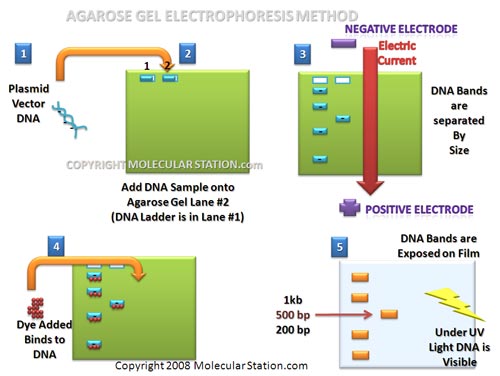
Agarose gel electrophoresis is used to separate DNA, or RNA molecules by size, however proteins can also be separated on agarose gels. Separation is achieved by moving negatively charged nucleic acid molecules through an agarose matrix in an electric field. Smaller/shorter molecules move faster and migrate further than longer ones.
Contents
Section titled “Contents”- Additional Resources
- Gel Percentage
- Pouring the Agarose
- Running the Gel
- Visualizing the Gel
- DNA Ladders
1. Additional Resources
Section titled “1. Additional Resources”- Please read Chapter 2 of our Molecular Cloning book
- Take a look at Agarose Electrophoresis protocol online.
- An excellent introduction PDF to practical considerations in running agarose gels.
- Text and Images Adapted From Molecular Station
2. Gel Percentage
Section titled “2. Gel Percentage”
3. Pouring the Agarose
Section titled “3. Pouring the Agarose”Almost all of our gels will use routine agarose from Genesee Scientific or Fisher. Solid agarose is added into 1x TAE buffer to a desired final concentration (weight/volume).
Example: to make 250 mL of 1% agarose, add 2.5 grams of agarose into 250 mL of 1x TAE buffer.- Heat the TAE-agarose mixture in a microwave, with gentle swirling every minute or so until the agarose is completely disolved. The mixture will need to be very close to boiling to make sure the agarose is dissolved completely.
- Cool the desired amount of agarose to ~55 oC by either leaving it on the bench or putting it in a water bath. Agarose will start to solidify below ~50oC.
- Add Ethidium Bromide to a final concentration of 0.5 μg/ml. Mix the gel solution thoroughly by gentle swirling. Ethidium Bromide is toxic and gloves should be worn at all times.
- Cast the gel in our Bio-Rad casting apparatus.
4. Running the Gel
Section titled “4. Running the Gel”- Place the gel in the running tank and fill the tank with 1x TAE to the fill line.
- Mix your DNA samples with 6x running dye and load the gel. Make sure to include the appropriate DNA ladder.
- Run the gels at constant voltage. Running the gels too fast will cause heating and melting of the agarose. This will lead to smeary gels.
- Small Bio-Rad gels: ~110V max recommended
- Large Bio-Rad gels: ~90V max recommended
5. Visualizing the Gel
Section titled “5. Visualizing the Gel”- Place the gel in a tupperware dish with DI water and rock gently for 10 minutes.
- Repeat the gel washing 1-2 more times.
- Place on the UV transilluminator and take a picture of the gel.
- Dispose of the gel in Ethidium Bromide waste.
6. DNA Ladders
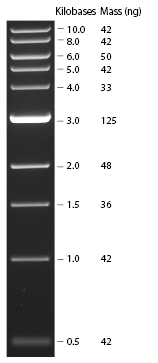
Section titled “6. DNA Ladders”Here are a few ladders that we use routinely.