Preparing Flowcells for Single Molecule Experiments
We use quartz slides (1 in. × 3 in. × 1 mm; G. Finkenbeiner) because they are fluorescence-free, and are index-matched to the TIRF prism. These slides are expensive (~$15/ea) so try not to break them during drilling and washing.
Contents
Section titled “Contents”1. Drill New Slides
Section titled “1. Drill New Slides”New slides are drilled with a diamond-tipped drill bit (iShor product #DIB-211.00). The silica slides shatter easily if drilled too quickly or with blunted drill bits. Work slowly, under a constant stream of running water, and change the drill bits frequently (maybe once per slide).
Wipe the metal drill-press thoroughly with paper towels so there are no wet spots remaining. Wet spots will form rust on the steel base and make Ilya angry.
If you’re making “ghetto-style” DNA curtains, scratch one side with a diamond-tipped drill bit. Make sure you mark the side that has been scratched.
2. Washing Slides
Section titled “2. Washing Slides”- Rinse in MilliQ H2O.
- Gently agitate in 2% Hellmanex cleaning solution for 4 hr to overnight, but overnight is recommended. Using a stirring bar improves the cleaning.
- Rinse thoroughly in H2O to remove all soap residue from slides and staining dish.
- Soak 1 hr in fresh 1 M NaOH with a stirring bar.
- Rinse again with water to remove all traces of NaOH.
- Soak in 100% ethanol for 1 hr to overnight.
- Dry slides with a stream of dry nitrogen.
- Bake the slides at 120˚C in a vacuum oven for overnight. Cleaned silica slides that have not been assembled into flowcells may be stored in the vacuum oven indefinitely.
3. Constructing Flowcells
Section titled “3. Constructing Flowcells”The flowcell is constructed from a segment of double-sided tape sandwiched between a silica microscope slide and a glass coverslip. Nanoports (IDEX #N-333 (dead link)) are attached to pre-drilled holes in the silica slides. In practice, 5–10 flowcells are assembled simultaneously and stored in a vacuum dessicator for up to a week at room temperature, but prolonged storage compromises surface quality, which can prevent deposition of a fluid bilayer. 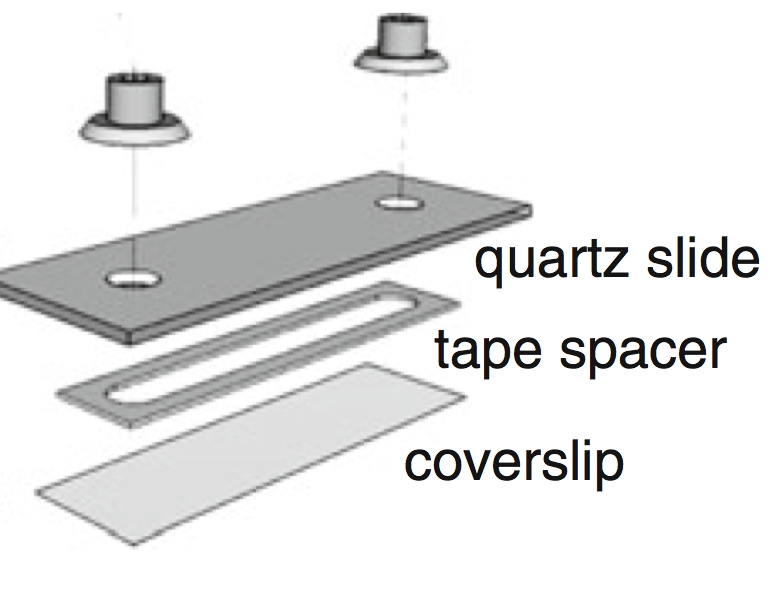
- Do not begin this section until you’ve drilled, cleaned and baked your slides.
- Make sure you have some paper channels cut. Here is a PPT template. These are the shorter, better templates.
- Mask off a segment of double-sided tape with a narrow strip of paper. This paper will eventually be cut out, and the resulting channel in the tape will form the observation chamber for microscopy experiments.
- Place the double-sided tape over the silica slide. Make sure that both ends of the paper cover the drilled holes and that the paper template covers the chrome nanopattern.
- Cut out the paper template using a razor blade. Keep close to the template, ensuring that the tape does not cover the holes.
- Blow dust off a new coverslip (Fisher #12-548-5E (dead link)). Place the coverslip over the double-sided tape. With the razor blade, remove excess tape that is not covered by the coverslip.
- Sandwich the flowcell between two clean, cheap microscope slides. Apply even pressure with four small binder clips, and bake in a vacuum oven at 120◦C for up to an hour. Over-baking will cause the tape to melt and potentially cover the drilled holes.
- The nanoports are attached with a low-temperature melting hot-glue gun to the quartz slide. Make sure your glue melts completely and you press down on the nano-ports or they will pop off when you try to use them.
- The assembled flowcells may be stored at room temperature under vacuum for up to a week without significant degradation to the flowcell surface and lipid bilayer fluidity.
4. Recycling Flowcells
Section titled “4. Recycling Flowcells”Quartz slides can be recycled. Nano-patterned slides should be used until the pattern is worn off.
- Soak used flowcells in 100% ethanol for minimum of two days until the nanoports fall off and the double-sided tape starts to dissolve.
- Gently slide the coverslip off the quartz slide and remove all remaining glue off the slide. Make sure you do not rub the Cr patterns.
- Wash the slide as described above.
- For scratched slides, occasional plasma or Piranha cleaning may be useful.
- Be careful with harsh cleaning of nano-fabricated slides – plasma cleaning may be ok.